Tandara – Family Genealogy
Introduction
This page does not focus on explaining the origin of the surname, but on relationships between people, generations and family branches. Its purpose is to make it clear who belongs to whom, how each line continues, and where the available documentation comes to an end.
The historical background of the surname is presented in the Origin section, while the movement of individual branches is covered on the Migration page. Genealogy therefore remains the central place for the structure of the family and verified family relationships.
How to read the genealogy
The family trees are read from older to younger generations. Each person is placed within the appropriate family line, and the links between parents, children and spouses make it possible to follow the branching of the family without repeating general historical descriptions.
Text accompanying the tree adds information only where a diagram needs explanation or context. This keeps the genealogy clear, while historical, migration and other background material remains on the pages specifically devoted to those subjects.
Research Sources and Bibliography
The Tandara genealogy is based on archival and published sources listed in the bibliography supplied with the research material. For clarity, the sources are divided into unpublished and published materials.
A special place in this research is held by the works of Milan Lažeta, Rodoslovlje plemena Tandara and Ričice u nama, as well as Viktor Vito Grabovac’s publication Ričice kroz vijekove. These valuable works laid the foundation for further study of the history and origins of our family and remain among the most important sources for understanding the heritage of the Tandara surname and family line.
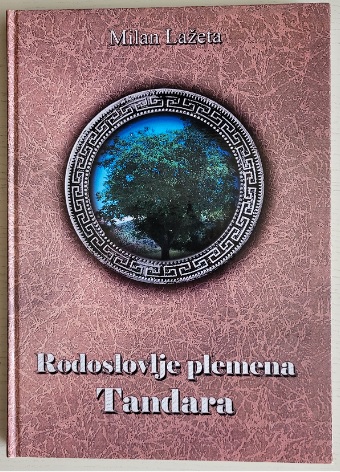
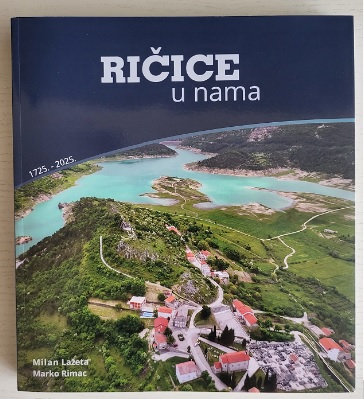
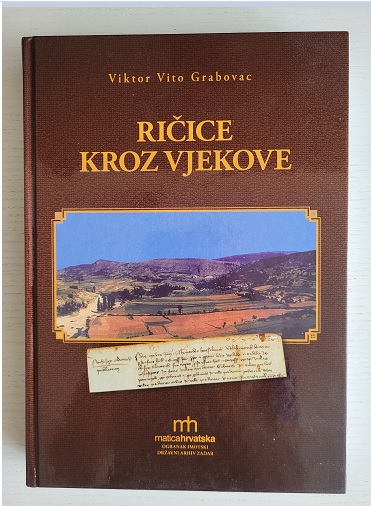
Unpublished sources
Croatian State Archives
Parish of Ričice
- Dijapozitiv M – 3704: register of births 1761–1784 and 1786–1827; register of marriages 1787–1827; register of deaths 1787–1827; Status animarum for 1819.
- Dijapozitiv M – 3120: register of births, Parice, 1817–1887.
- Dijapozitiv M – 2307: register of births, Parice, 1849–1856.
- CD reference 242: register of births, Parice, 1857–1887 (ZM 34F – 935; M00532729 to M00533031).
- Dijapozitiv M – 3121: register of births, Parice, 1888–1940 (the years 1914, 1915, 1917 and 1918, and the period 1922–1926 are missing); register of marriages, Parice, 1817–1901 (the period 1860–1868 is missing).
- Dijapozitiv M – 3122: register of marriages, Parice, 1901–1940; register of deaths, Parice, 1817–1920.
- Dijapozitiv M – 3123: register of deaths 1920–1940.
Parish of Livno
- Dijapozitiv M – 3226: register of baptisms 1849–1883, 1894–1912 and 1913–1925.
- Dijapozitiv M – 3227: register of baptisms 1925–1933 and 1934–1946; register of marriages 1849–1883, 1884–1919 and 1919–1946.
Parish of Čuklić near Livno
- CD reference: Čuklić: register of deaths 1884–1899 (M00141238 – M00141342); register of deaths 1900–1914 (M00141344 – M00141478); register of marriages 1884–1913 (M00142129 – M00142234); register of marriages 1913–1942 (M00142236 – M00142400); register of baptisms 1828–1883 (M00143296 – M00143567); register of baptisms 1884–1893 (M00143574 – M00143690); register of baptisms 1894–1910 (M00143693 – M00143…); register of marriages 1828–1883 (M00147163 – M00147…); confirmation register for the years 1839, 1851, 1853, 1856, 1862, 1872 and 1879.
Archdiocesan Archives in Split
- List of families in Ričice, 25 July 1739. File – M 67.
- Visitation record of the Diocese of Makarska, list of confirmands in the parish of Ričice for 1779, 1786 and 1792. File – M 110.
- Status animarum of the parish of Ričice for 1806.
State Archives in Zadar
- Venetian cadastre of the 17th and 18th centuries, No. 41, sheets 6, 7 and 8 and 12–16. Records concerning the distribution of land to families in the village of Ričice in 1725.
- Records of the Provveditore Generale (1754–1756), Fascicle 1. Bn. Pušić – Village of Ričice.
- Austrian cadastre of Ričice. Collection of cadastral maps of the village of Ričice and House Register of the cadastral municipality of Ričice, 2 November 1835.
State Archives in Split
- Map Archives for Istria and Dalmatia, Cadastre of Dalmatia 1823–1975.
- Register of building parcels in the cadastral municipality of Ričice from 1835.
- List of all landholders in the cadastral municipality of Ričice, 1877.
- Statement of the landholdings of all owners with a list of all land parcels and buildings from 1883 in the cadastral municipality of Ričice.
Municipality of Imotski
- Birth register of the parish of Ričice, 1940–2011.
- Marriage register of the parish of Ričice, 1941–2011.
- Death register of the parish of Ričice, 1921–2011.
Published sources
- P. Dominicus Mandić, o.f.m., Chroati catholici Bosnae et Hercegovinae in descriptionibus annis 1743 et 1768 exaratis.
- Imotski zbornik 1, Imotski, 1992; Slavko Kovačić, Obitelji iz imotskih i radobiljskih sela u zbjegu u selima ispod Zadvarja god. 1686.
- Zov rodnih ognjišta, parish bulletin of St Luke – Kučiće, Year IX, 2003, no. 2 (17); Fr Slavko Kovačić, Bantulovići, Bilići i Bošnjaci u Kučićima.
- Milan Lažeta, Izlet u prošlost obitelji Lažeta.
- Milan Lažeta, Rodoslovlje ričićkih Kneževića.
- Tomislav Perković, Stanovništvo livanjskog polja u 18. i 19. stoljeću.
This list forms the documentary basis of the genealogical research. Individual genealogical statements may also be compared with family papers, photographs and oral testimony, but such supplementary information is distinct from the archival and published sources listed above.
Reliability and limits of the sources
The reliability of the information is not identical for every period. Fewer direct records survive for the earliest generations, while parish registers and later documents allow people and family relationships to be connected with much greater certainty.
When different sources do not agree, or when direct confirmation is missing, the information is not treated in the same way as a fully documented fact. Such points remain open for further verification and future additions.
Development of Family Branches
As the number of family members increased, individual households began to form their own separate units. From a single original family, distinct branches gradually emerged, remaining connected through shared ancestry.
Although they lived in different parts of the village or later in other places, the awareness of belonging to the same lineage was preserved across many generations.
Family and Everyday Life
Throughout most of the eighteenth and nineteenth centuries, members of the family lived primarily from agriculture and livestock farming, which was typical for the population of the Imotski region. Family households often included several generations under the same roof. This way of life helped preserve common property, ensured mutual support and enabled the transfer of experience between older and younger family members.
Family Trees
The central part of this genealogy consists of family trees. They provide an overview of all known generations and clearly show the connections between individual branches of the lineage.
For each person, whenever information was available, the following details are listed:
- year of birth,
- year of death,
- name of spouse,
- children,
- place of residence.
This makes it possible to easily follow the development of the family over time.
Public and Protected Genealogical Records
The public genealogical display contains only information that may be published under the archive rules. Protected information is kept separately and does not change a person’s position in the family tree; it changes only the amount of information visible to the public. Detailed publication and protection rules are set out in the Privacy Policy.
Requests for corrections, additions or access to protected information are submitted through Contact & Collaboration and are reviewed individually.
Photographs and Family Heritage
Photographs, old family documents and other historical materials give special value to the genealogy. Such material complements written sources and helps preserve not only names and dates but also fragments of everyday life of earlier generations.
Each new photograph or document represents a valuable contribution to the further development of this project.
Corrections and additions
Genealogical information is changed only when a new document, photograph or reliable family record provides information that can be linked to an existing person or branch. A new claim does not automatically replace an existing entry; it is first compared with the sources already collected.
This approach allows each addition to remain part of the same genealogical structure while errors can be corrected without losing previously established relationships.
Conclusion
The value of this genealogy lies not in repeating historical descriptions, but in the clarity of the family relationships it presents. Its task is to show continuity between generations, the branching of family lines and the points at which documentation is still incomplete.
Genealogy therefore serves as the central map of the family, while historical, geographical and linguistic explanations remain in separate thematic sections.